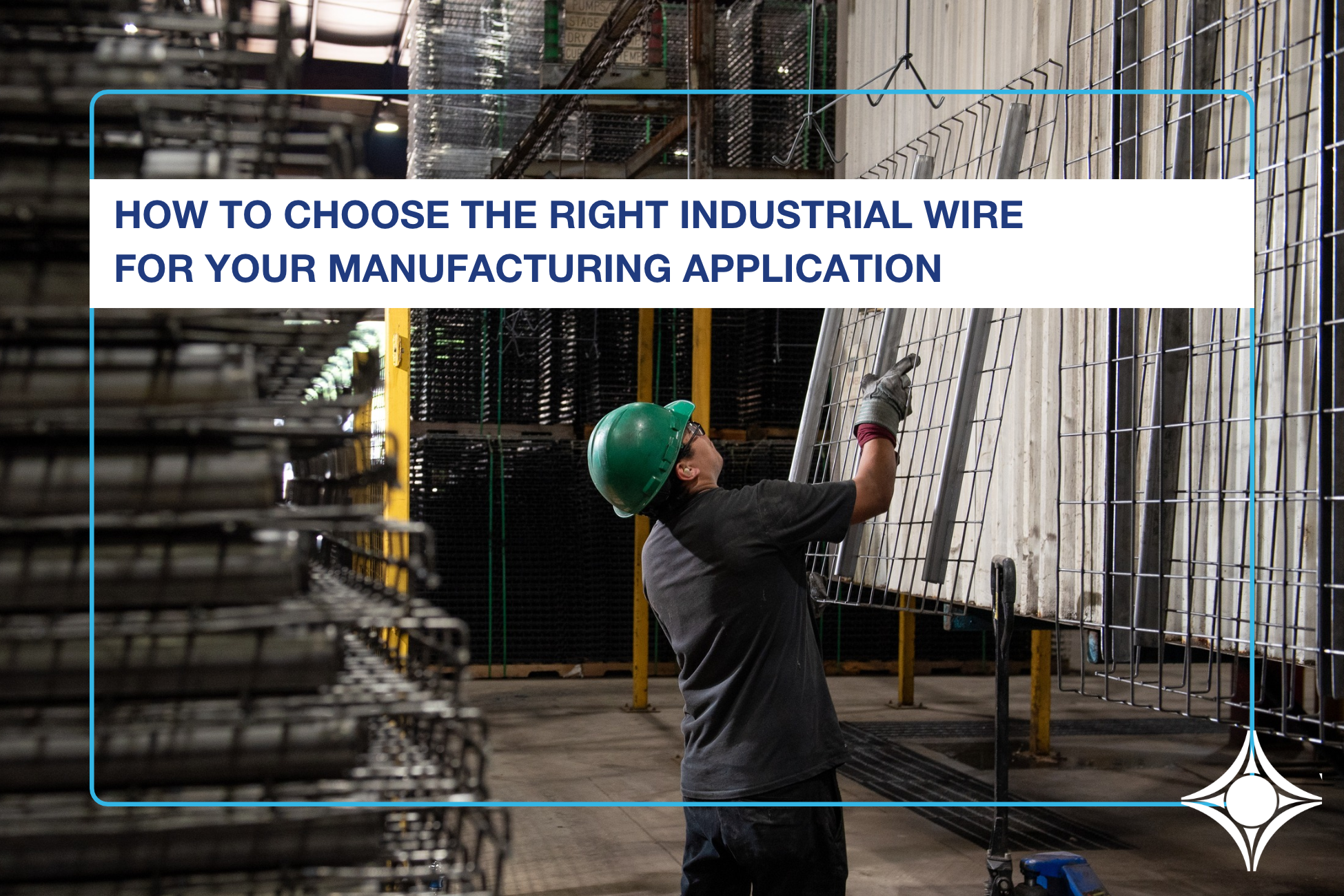
How to Choose the Right Industrial Wire for Your Manufacturing Application
Choosing the wrong industrial wire can lead to breakage, rework, downtime, and product failures that impact both productivity and costs. Industrial wire is used across a wide range of manufacturing and industrial applications, each with unique requirements for strength, corrosion resistance, ductility, and performance. Understanding which wire best fits your operation can help improve efficiency, product quality, and long-term reliability.
Below are some common manufacturing needs, the wire products that best match them, and several mistakes to avoid when selecting an industrial wire solution.
When Surface Finish Matters: Plating Quality Wire
If your application requires a smooth, polished surface that delivers consistent results in chrome plating, powder coating, or other high-quality finishing processes, Plating Quality Wire is an excellent choice.
Manufactured from low-carbon steel under strict quality standards, this wire helps minimize surface defects and improve consistency throughout downstream operations. Its clean surface and reliable performance make it suitable for both finishing and welding applications.
Common uses include:
- Automobile parts
- Cable trays
- Carts
- Chromed wire forms
- Paint rollers
- Racks
- Retail displays
By starting with high-quality steel wire, manufacturers can improve finished product appearance while reducing rework and production inefficiencies.
For Secure Tying and Easy Forming: Black Annealed Wire
When flexibility and ductility are critical, Black Annealed Wire is a dependable solution. Produced from cold-drawn low-carbon steel, it undergoes an annealing process in a controlled nitrogen atmosphere that creates a clean, scale-free surface while enhancing malleability.
Its smooth surface, flexibility, and consistent performance make it easy to handle across a wide range of diameters, helping operators work more efficiently during tying, bundling, and securing applications.
Common applications include:
- Tie wire
- Securing parts for hot-dip galvanizing
- Construction projects
- Agricultural operations
- Recycling facilities
- General industrial processes
Its ability to bend easily without breaking makes it a preferred choice wherever reliable fastening is required.
When to Choose Bright Basic Wire
Bright Basic Wire is an excellent option when your application requires a clean, polished surface combined with increased tensile strength and dependable performance during bending, straightening, welding, or secondary coating operations.
This cold-drawn low-carbon steel wire conforms to ASTM A510 and ASTM A853 standards and provides the consistency manufacturers need for demanding industrial applications.
When evaluating steel wire suppliers, choose a partner that can meet your engineering specifications and provide the dimensions and mechanical properties your application requires.
Bright Basic Wire readily accepts a variety of finishes and coatings, including:
- Epoxy coatings
- Plasticized coatings
- Galvanized coatings
- Porcelain coatings
- Powder coatings
Typical applications include:
- Automobile parts
- Baskets
- Cages
- Chain-link fencing
- Concrete accessories
- Displays
- Hooks
- Nails
- Shelving
- Shopping carts
- Straight and cut wire
- Welded wire mesh
- Wire forms
Its versatility makes it one of the most widely used steel wire products across both industrial and commercial markets.
Avoid these mistakes when looking for industrial wire
1. Choosing on Price Alone
The price per ton or per coil is an important number, but it only tells part of the story. A lower-cost steel wire that breaks during drawing or forming, varies in diameter, or fails early in service can end up costing more through scrap, line stoppages, rework, and replacements.
When comparing options, look at the total cost of ownership:
- Process performance: Does the wire run consistently on your equipment?
- Quality consistency: Will coil-to-coil properties stay within your tolerances?
- Downtime risk: What happens to your production schedule if a batch underperforms?
- Service life: Will the finished product hold up in its real operating conditions?
It is the same principle that applies to infrastructure: the cost of a material is more than its purchase price.
2. Over-Specifying the Wire
It is tempting to choose the strongest, thickest, or most heavily treated option “just to be safe.” But more is not always better. A higher tensile strength can reduce ductility and make forming harder. Tighter tolerances or special finishes can add cost and lead time without improving performance.
The goal is not the highest specification. It is the right specification. Start from what the application actually requires in strength, flexibility, and durability, and specify to that.
3. Ignoring Coating Needs
Coatings are often treated as an afterthought, but they can determine how long a product lasts. Wire that will be exposed to moisture, outdoor weather, chemicals, or humidity may need zinc or another protective coating. Wire used in a dry, controlled environment may not.
Skipping a needed coating can lead to premature corrosion and failure. Paying for one you don’t need adds cost with no benefit. Consider where the product will operate, for how long, and what maintenance is realistic.
After keeping this advice in mind, finding the right industrial wire will be easier. If you still need to know more about industrial wire, just contact us. We want to help you to find the best option.